

Chuck Close is a photographer and painter who gained fame through photorealism. He took portraits of people and recreated them in paintings on a large scale. His concept behind the work is basically the same as what I am doing for my project. We both shot portraits of people and have attempted to recreate them with paint.
He worked hard to make the paintings look as if they were photographs. I have decided yet if I want my paintings to look as if they are photographs, or if they are painting recreations of a photograph. I think both are successful for different reasons.
What I found interesting about his methods of working is that he made a grid on his photos and recreated each grid individually when painting. I used the same grid style on my first piece, though I did not work one grid at a time; though I think I may try that with my next painting.
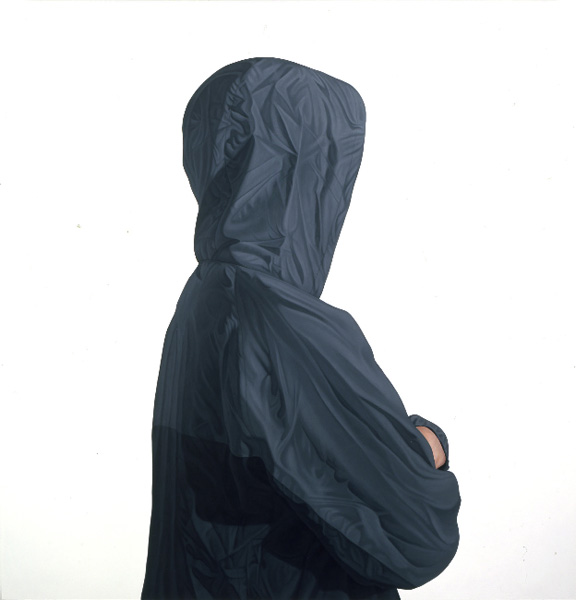
Karel Funk created realistic looking paintings, almost as if they were photographs of the backs or sides of strangers. He wanted to convey that moment when you’re forced to look intimately at the back of a stranger’s head, but I didn’t want there to be any emotional connection. He got his inspiration from spending so much time commuting on the subway in New York City. Unlike traditional portraiture, in which the subject typically locks eyes with the viewer and background details provide clues about them, Funk’s subjects face away from us or have their eyes closed, as if they’re unaware of our presence
Funk and I both possess the quality that we are interested and intrigued by people and portraiture; though we have different ways of executing this interest. Funk has focused on showing that there can be such a disconnect when all we can see the side of back of someone. By not allowing the viewer to see a face, there is no emotion that can be taken from the painting, and the question the viewer is left with, is who is that person? I personally am more interested in the emotional connection a viewer can gain from the face in portrait though.
Funk photographs his models in poses against white backgrounds, and later refers to the digital images on his computer screen while he paints, inventing as he goes until, in the home stretch, he ignores the photographs entirely. Though we have different ways of portraying people and portraits, we both use the same concept of taking photographs and turning them into paintings.


Diane Arbus was a photographer known for her black and white portrait photographs. She was known as "the photographer of the freaks." Though I could not find much information about her process of her work, she definitely had an eye for capturing portraits. All of her work that I could find was done in black and white. Though the portraits I am making are in color, I have focused on black and white photography.
She had an amazing way of being able to show such emotion and a story in just one photograph. Portrait photography aims for this, and distinguishes those whom are actually photographers and those who use their iphone to take pictures. Arbus has managed to capture people in their own settings being themselves, something I work hard to do with my photos.
She had an amazing way of being able to show such emotion and a story in just one photograph. Portrait photography aims for this, and distinguishes those whom are actually photographers and those who use their iphone to take pictures. Arbus has managed to capture people in their own settings being themselves, something I work hard to do with my photos.


